Is Tether a dollar, and is rNVDA an NVIDIA share? Three ways to hold U.S. stocks
From share certificates to brokerage ledgers and blockchain: ownership, voting rights, dividends and the Korean tax question.
English
Physical certificates / direct registration
- Investor
- Issuer’s shareholder register
- Actual U.S. shares
Directly registered shareholder
Brokerage account
- Investor
- Broker’s electronic ledger
- Depository / custodian
- Actual U.S. shares
Rights to actual shares
Tether (USDT)
- Investor
- USDT dollar token
- Tether / reserve management
- Cash, U.S. Treasuries, etc.
Token linked to the dollar’s value
Reality (rNVDA)
- Investor
- rNVDA stock token
- Reality / custodian
- Actual NVIDIA shares
Economic rights linked to shares
Even when backed by real assets, legal rights differ depending on how they are held.
USDT is widely used as a dollar substitute in crypto markets, but its holders do not directly own dollar bills or Treasury securities. Reality’s rNVDA, traded on Bitget, similarly gives exposure to NVIDIA shares through a digital token. Even conventional brokerage investors usually do not receive paper certificates or appear personally on the issuer’s shareholder register. What exactly changes across these three forms of ownership?
1. What Tether and Reality have in common
Both products bring the economic value of conventional assets onto blockchain networks. Tether holds reserves including cash equivalents and U.S. Treasuries to support its dollar peg. Reality states that its rTokens are backed by corresponding stocks or ETFs held through brokerage and custody arrangements. A token designed to track an NVIDIA share is not itself an NVIDIA-issued share. Reserve backing, legal ownership, redemption rights and distribution policies must be distinguished.
2. Three ways to hold U.S. stocks
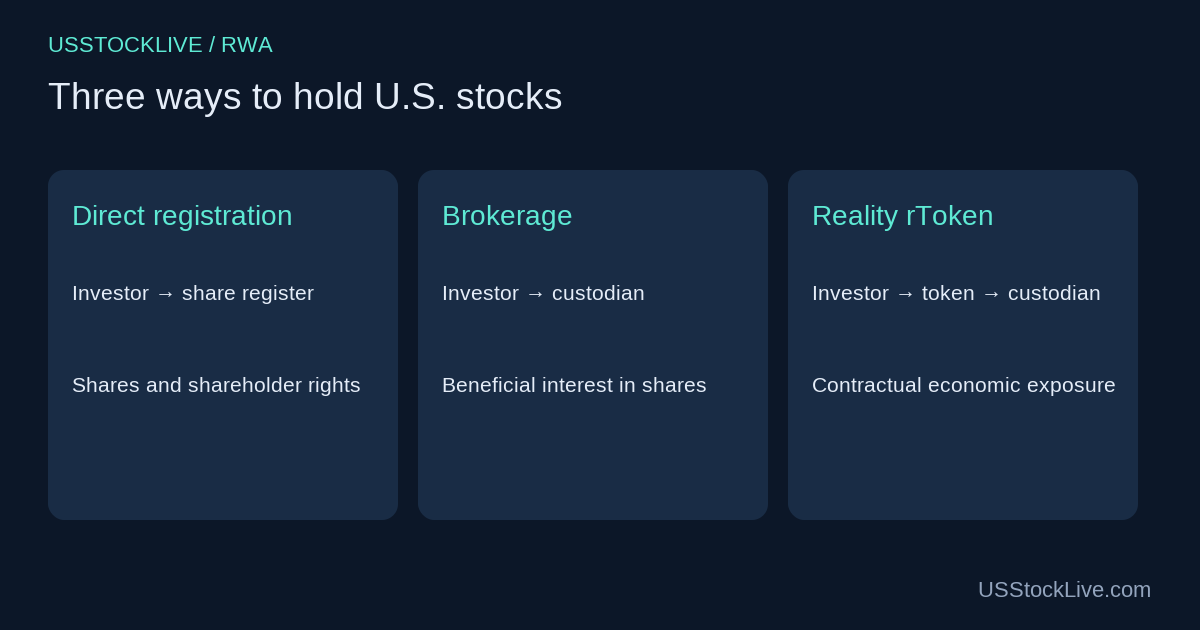
Direct registration places the investor on the issuer’s or transfer agent’s register. Paper certificates may also evidence ownership, where available. With a Korean brokerage, securities typically pass through domestic and overseas custody systems, including the Korea Securities Depository, and the investor has rights recorded in a brokerage account. With Reality, the investor holds a token representing contractual economic exposure, while underlying shares are held in custody. These arrangements can track the same asset without conferring identical legal rights.
3. Comparing direct, brokerage and tokenized holdings
The three approaches differ in how rights are recorded, what can be transferred and which legal safeguards apply. Tokenized shares can support fractional trading, USDT settlement, blockchain transfers and collateral use where the product and network permit. Traditional securities generally trade in USD and follow market and broker hours.
| Feature | Direct registration | Brokerage | Reality rToken |
|---|---|---|---|
| Asset | Registered share | Rights to shares | Stock-linked token |
| Voting | Yes, if eligible | Via intermediary | Generally no |
| Dividends | Yes, if declared | Yes, if declared | Eligible USDT distribution |
| Weekend trading | No | Usually no | Supported tokens |
| Transfer on-chain | No | No | Where supported |
| Korean tax | Foreign-stock regime | Foreign-stock regime | Classification unresolved |
4. Voting rights and dividends
Shareholders of voting common stock can participate in corporate governance, including director elections. Directly registered investors can exercise voting rights; brokerage customers may vote via the relevant intermediary procedures. Reality rToken holders generally lack shareholder voting rights. According to Bitget, eligible cash dividends are credited in USDT net of applicable withholding, and supported splits and stock distributions are reflected in token balances. Economic exposure is not the same as shareholder status.
5. Can Korea tax rToken gains as foreign-stock capital gains?
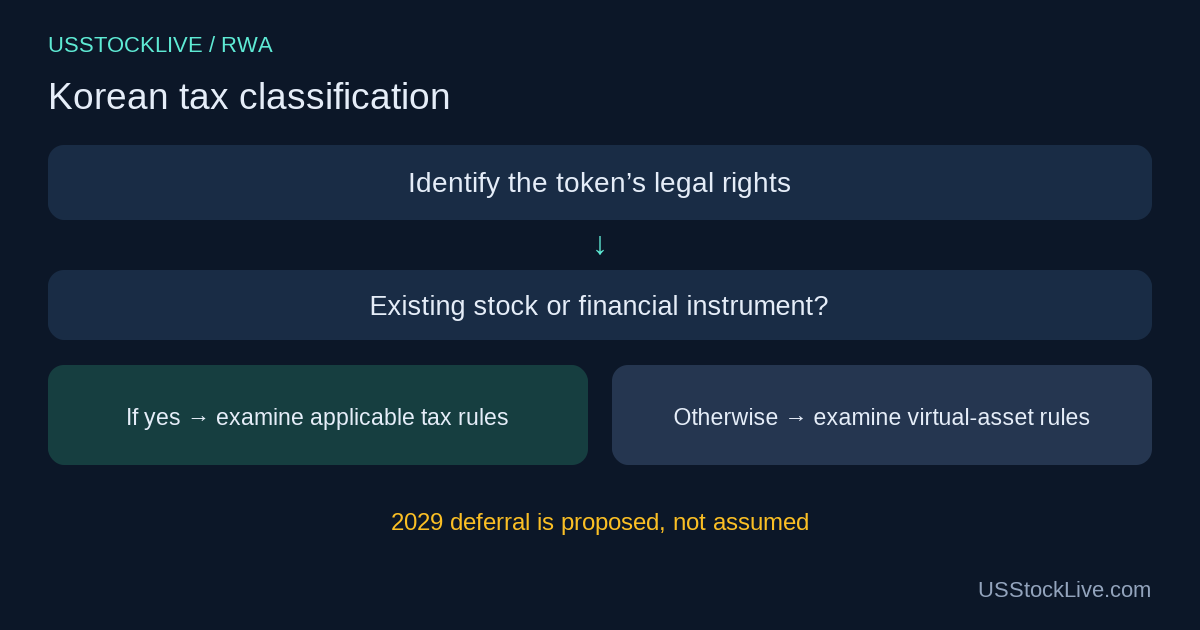
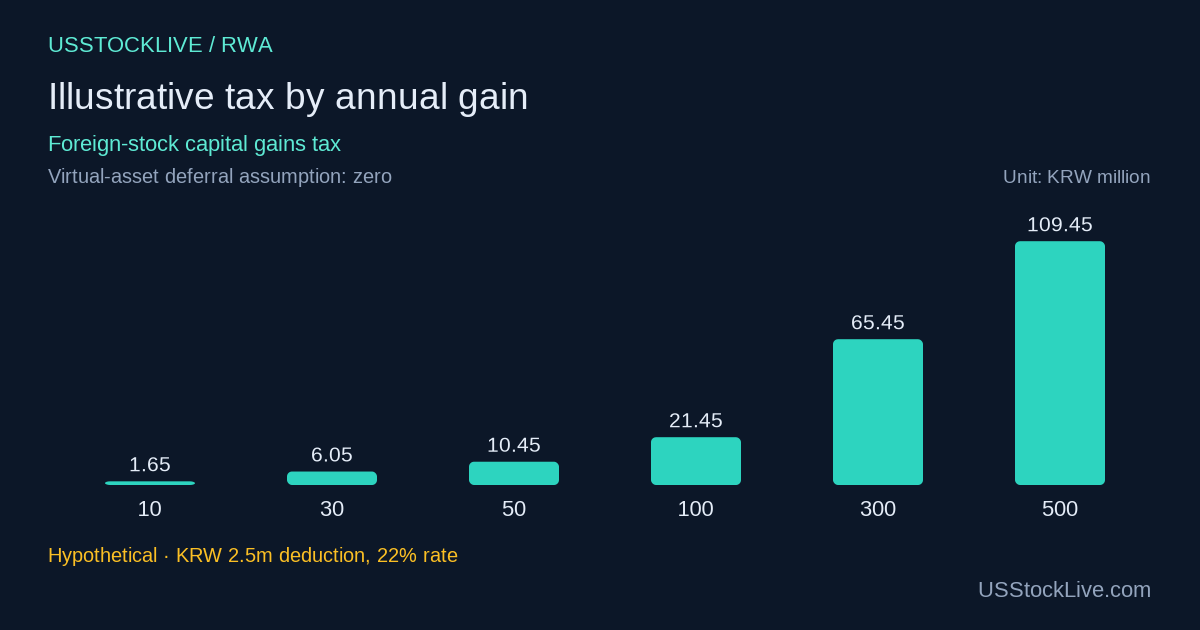
For a Korean resident individual, ordinary foreign-stock capital gains are generally taxed at 22% including local income tax after an annual KRW 2.5 million deduction. The question is whether the token itself falls within the taxable categories in the Income Tax Act, including Articles 88 and 94. Korea’s constitutional principle of statutory taxation requires a legal basis. Article 14 of the Framework Act on National Taxes looks to economic substance, but does not create a new taxable category by itself. USDT is not treated as a Treasury bond simply because Treasury securities are held in reserve. Likewise, rNVDA is issued by Reality rather than NVIDIA. The classification must examine whether the token constitutes shares, equity interests, depositary receipts, derivatives, trust or other financial rights, or virtual assets. Bitget distinguishes rTokens from its Stock+ share product; that distinction is relevant but not dispositive for Korean tax law. Virtual-asset income taxation was originally scheduled for 2022, subsequently postponed to 2023, 2025 and 2027. On November 5, 2026, the government proposed a further two-year delay to 2029; a bill followed on November 9. The parties reached provisional agreement on November 11, but final adoption was not confirmed by that agreement. The illustration below assumes the token falls solely under the virtual-asset regime and the further deferral becomes law. It is not a determination of rToken tax status. Dividend distributions and lending rewards require separate analysis.
Capital gains from trading stock tokens
- Does the token qualify as shares or equivalent under the Income Tax Act (Articles 88 and 94)?
If yes
- Foreign-stock capital gains tax
- KRW 2.5 million basic deduction · generally 22%
If no
- Check other taxable categories: derivatives, beneficial interests, etc.; apply relevant rules if eligible
- If no other taxable category applies, assess whether it qualifies as a general virtual asset
- If it qualifies, virtual-asset tax deferral may apply
- If no applicable legal basis for taxation exists, no tax can be imposed
Conditional classification framework; the actual tax classification of Reality tokens has not been established.
| Annual gain (KRW m) | Foreign-stock tax (KRW m) | Assumed deferred tax (KRW m) |
|---|---|---|
| 10 | 1.65 | 0 |
| 30 | 6.05 | 0 |
| 50 | 10.45 | 0 |
| 100 | 21.45 | 0 |
| 300 | 65.45 | 0 |
| 500 | 109.45 | 0 |
6. Converting brokerage shares into tokens
In October 2026, Bitget introduced transfers involving eligible U.S. securities and rTokens. Supported shares can be moved into the token ecosystem and eligible tokens can be transferred back through brokerage arrangements. The published guidance describes restrictions on fractional shares and account ownership, fees and processing times. Korean brokerage compatibility and whether conversion constitutes a taxable disposal remain questions to verify.
7. Can U.S. stock prices move over the weekend?
The traditional U.S. market closes on weekends and holidays, while supported rTokens may continue trading. Suppose NVIDIA closes Friday at $150. A token price of 145 USDT on Saturday and 141 on Sunday would represent hypothetical gaps of −3.33% and −6.00%. USStockLive compares token prices with the latest U.S. close. Liquidity, spreads and USDT deviations can influence token prices; they do not guarantee the next opening price.
8. What if the exchange or issuer fails?
One-to-one backing does not establish direct ownership or identical bankruptcy protection. Reality describes segregated custody and independent reserve attestations. Risks remain: issuer or exchange insolvency, restricted withdrawals, custody failure, smart-contract errors, USDT volatility and regulatory change. SIPC protection for an underlying brokerage does not automatically cover every token holder. The contractual claim, asset segregation and recovery priority matter.
9. From paper certificates to blockchain
Paper certificates, electronic securities ledgers and tokens represent different ways of recording assets. Tokenization can extend trading hours, enable smaller positions and integrate stock exposure with digital-asset services. But the tax treatment, governance rights and recovery process are essential to evaluating this evolution. The central question is not only what the asset tracks, but what the investor actually owns under the law.
Sources and references
Market data and disclosure
Market prices and reporting reflect the stated timestamps. Tokenized prices need not match U.S. cash-session stock prices. This is not investment advice.
Comments 0